

How to Visit Koh Ker: Cambodia's Forgotten Pyramid City
Chasing Shadows in the Jungle: The Ultimate Guide to Koh Ker, Cambodia’s Lost Pyramid
Everyone tells you to visit Angkor Wat when you come to Cambodia. And don't get me wrong -watching the sun rise behind those iconic lotus towers is a travel rite of passage. But if you are anything like me, fighting through a sea of selfie sticks at 5:00 AM can make an ancient wonder feel a bit like an amusement park.
That is exactly what drove me to leave Siem Reap behind for a day and head deep into the northern wilderness. My destination? Koh Ker.

For a brief, tumultuous decade in the 10th century, this remote jungle outpost replaced Angkor as the capital of the Khmer Empire. It was abandoned to the elements for nearly a thousand years, and today, it is home to something you’d never expect to find in Southeast Asia: a massive, seven-tiered Mayan-style pyramid slicing through the jungle canopy.
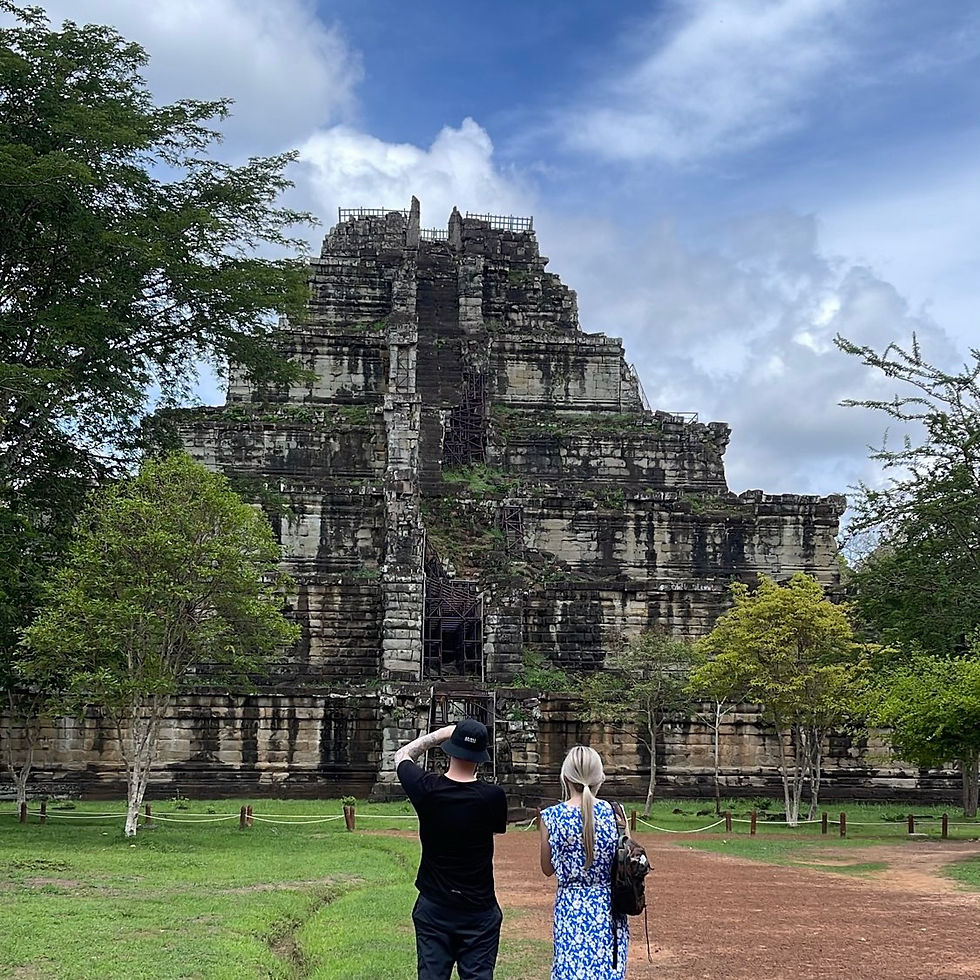
If you are looking for an adventure that feels less like a tourist itinerary and more like a discovery, here is my personal, comprehensive guide to exploring Cambodia's forgotten capital—including a hidden, root-strangled gem most people miss.
1. First Stop: The Root-Strangled Towers of Prasat Pram
Before you even reach the great pyramid, your vehicle will pull up to a site that will instantly make your jaw drop: **Prasat Pram** (which literally translates to "Five Towers").
Most travelers are so eager to see the pyramid that they breeze past the outlying structures, but letting my driver pull over here first was the best decision of the day, Prasat Pram consists of five ancient brick shrines and libraries enclosed by a crumbling laterite wall. What makes this place utterly magical is the raw, untamed power of nature on display. Two of the main brick towers have been completely, aggressively overtaken by massive strangler fig trees.

The roots don’t just wrap around the stone; they cascade down the walls like melted wax, gripping the bricks so tightly that the trees and the ancient architecture are now physically keeping each other standing. Because it sits right near the entrance of the archaeological loop, arriving early means you get the soft morning light filtering through the leaves with absolutely no one else around. It rivals the famous *Tomb Raider* temple (Ta Prohm) in Angkor, but without the wooden boardwalks and crowds.
## 2. The Rebel King and the Cursed Capital
To understand why Koh Ker feels so radically different from the rest of Cambodia's temples, you have to look at the guy who built it: King Jayavarman IV,
In 928 AD, after a bitter feud over the Angkorian throne, Jayavarman IV basically packed his bags, marched 120 kilometers northeast into the dense, malaria-ridden jungle, and declared himself the rightful ruler. To prove his divine power, he engaged in a massive, breakneck construction boom.
Unlike the sprawling, flat layouts of traditional Khmer temples, Jayavarman IV went vertical. He built **Prasat Thom**, a 36-meter-tall (118 ft) sandstone pyramid that served as his state temple.
The bizarre architecture and his sudden, aggressive break from Angkor fueled centuries of local folklore. For generations, nearby villagers whispered that Koh Ker was a cursed place, built to worship dark spirits, and that a bottomless sacrificial pit lay at the top of the pyramid. When Jayavarman IV died, the capital was promptly moved back to Angkor, leaving this megalithic city to be completely swallowed by the jungle.
3. Clambering Up the Great Pyramid (Prang)
Emerging from the trees onto the clearing of the main Prasat Thom complex is an unforgettable moment. The central pyramid, known locally as the Prang, genuinely looks like it belongs in the fields of Guatemala or Mexico rather than rural Cambodia.
The seven tiers of sandstone are heavily weathered, with moss and small trees clinging to the cracks. There used to be a crumbling, ancient stone staircase on the eastern side that was completely unusable, but thankfully, a safe wooden staircase has been built around the back.
It is a steep, sweaty climb to the top, but the reward is a 360-degree view of absolute green wilderness stretching all the way to the Dangrek Mountains on the Thai border. Standing up there, looking out over an ocean of trees, you really understand just how isolated this capital was.
## Practical Info for Planning Your Adventure
Koh Ker is no longer the completely unreachable outpost it was twenty years ago, but it still requires some planning.
Getting There: It is about a 2 to 2.5-hour drive from Siem Reap. The roads are entirely paved and in great condition. I highly recommend hiring a private driver or booking an organized day trip.
* **The Entrance Fee:** Tickets cost **$15 USD**. Keep in mind that Koh Ker is *not* included in the standard Angkor Pass, so you will need to buy this separate ticket at the entrance booth down the road from the site.
UNESCO Status:* Koh Ker is officially designated a *UNESCO World Heritage Site*. While this means more conservation funding, it also means crowds are slowly starting to grow. Go now before the massive tour buses make it a permanent stop!
**Travel Light & Hydrate:** There are a few small shack restaurants near the entrance selling basic fried rice and cold water, but once you are inside the temple loops, facilities are non-existent. Bring a good water bottle, high-SPF sunscreen, and bug spray the jungle mosquitoes do not play around.

* 🚐 **Day Trips & Private Drivers:** To get to Koh Ker and nearby hidden ruins without the stress of navigating rural roads, check out the customizable day itineraries on Viator (Koh Ker & Beng Mealea Tours). Booking a local driver through here is the safest and most reliable option.
The Verdict: Is Koh Ker Worth It?
If you only have two days in Cambodia and want to check off the classic sights, stick to the main Angkor park. But if you have an extra day, or if you are a history buff who craves the feeling of genuine exploration, **Koh Ker is absolutely non-negotiable.**
From the root-choked brickwork of Prasat Pram to the soaring heights of the great step pyramid, there is an eerie, beautiful romanticism to a place that human history briefly elevated to greatness, only to abandon it back to nature.
**Have you ever explored a ruin that felt totally forgotten by the world? Would you climb Cambodia's hidden pyramid? Let me know in the comments below!**


Comments