
The "Hydraulic City": How the Khmer (Cambodian) Masters Controlled of the Monsoon
- Around Cambodia Travel
- May 15
- 2 min read

After 18 years of walking these temple stones, I’ve learned that most visitors look up at the towers, but they forget to look down at the ground. To truly understand Angkor, you have to understand water.
The Khmer Empire didn’t just build temples; they built a "Hydraulic City." Without the ability to move, store, and control water, the Angkor we see today would have literally collapsed into the sand centuries ago.

More Than Just a Pretty View: The Engineering of the Moat
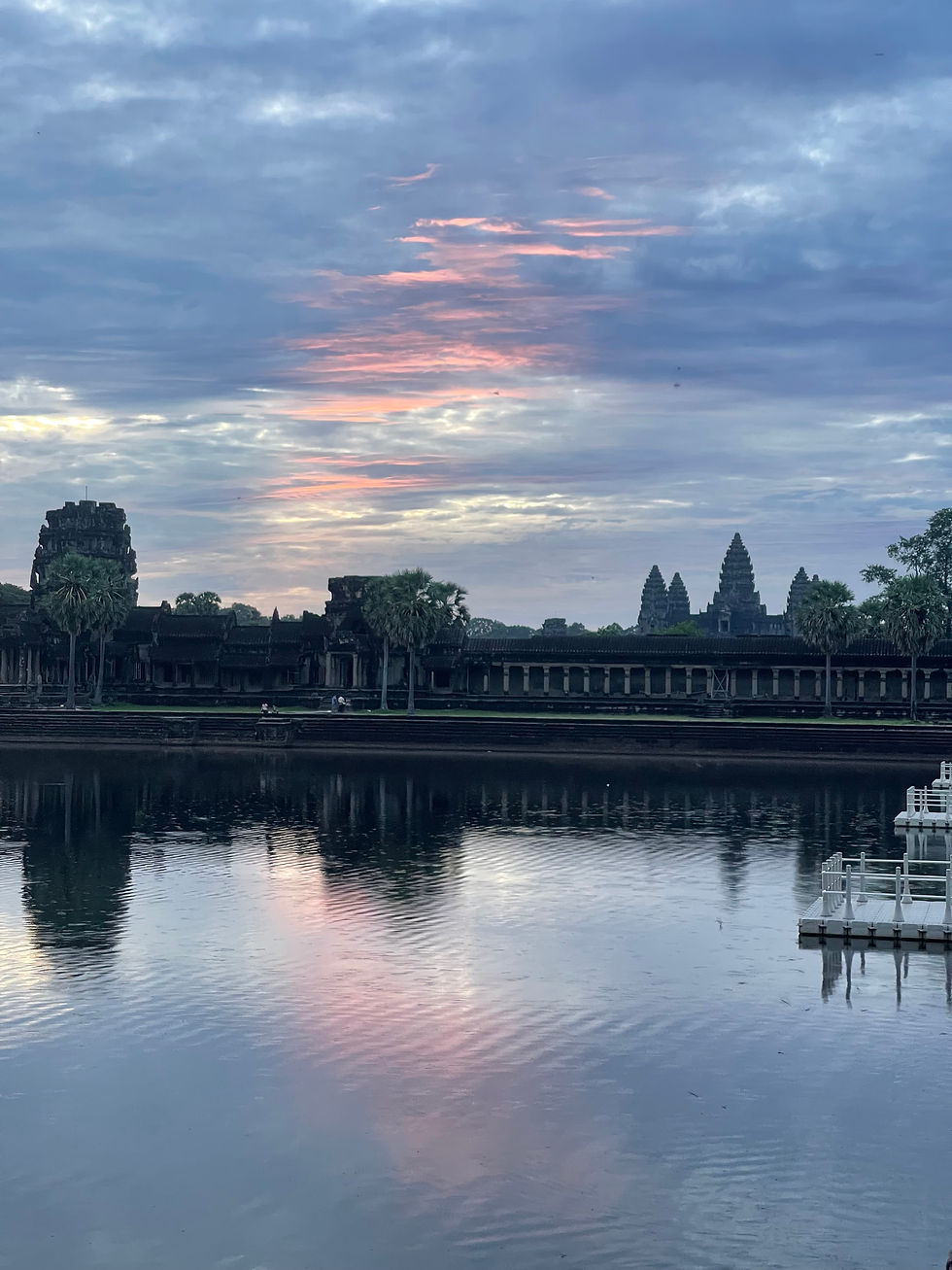
Whenever I lead a group to the edge of the Angkor Wat moat, I ask them: "Why is this here?" Most people say "defense" or "religion." While it does represent the cosmic ocean surrounding Mount Meru, its real job is invisible.
Angkor Wat sits on a massive bed of sand. Sand is stable only when it’s wet. If the water table under the temple dropped during our long dry seasons, the sand would shift, and the 100,000 tons of stone above it would crack and crumble. The 190-meter-wide moat acts as a giant hydraulic pressure pad, keeping the ground under the temple perfectly saturated and stable all year round.

The Barays: Managing the Monsoon
Our ancestors faced a challenge: too much water in the monsoon and not enough in the dry season.
Their solution? The Barays.

Imagine hand-digging a reservoir like the West Baray—8 kilometers long and 2.1 kilometers wide. These weren't just lakes; they were engineering masterpieces that used the natural 40km slope from the Kulen Mountains down to the Tonle Sap Lake.
• Gravity Power: By building dikes and canals on a gentle gradient, they moved water across 1,000 square kilometers without a single electric pump.

• Triple Cropping: This system allowed farmers to grow rice two or three times a year, feeding a population of nearly a million people at its peak.
The Source: Kbal Spean and the Siem Reap River
The water wasn't just physical; it was blessed. Up in the Kulen Hills, at a site called Kbal Spean, the Khmer (Cambodian) carved thousands of Lingas into the riverbed. As the water flowed over these carvings, it became "sanctified" before traveling down through the canals to the city below.

It was a perfect loop of spirituality and survival—until the climate changed. Severe droughts and sediment eventually broke the "exquisitely tuned machine," teaching us a lesson about sustainability that I still share with my guests today.
See the Magic of Angkorian Engineering
If you want to see these hidden canals and the massive Barays for yourself, I invite you to join one of our specialized tours.
We don't just show you the stones; we show you how the city lived.
• Book the Full-Day Angkor Highlights & Sunrise Tour – See the moats at their most beautiful at dawn.
• Private 3-Day Hidden Gems & Remote Temples – Explore the water sources at Kulen Mountain and Kbal Spean.
• Angkor Wat Sunrise Jeep Tour (Off the Beaten Path) – Follow the ancient canal lines through the jungle.
#AngkorWat #HydraulicCity #KhmerEmpire #SiemReapTravel #VisitCambodia #AncientEngineering #TravelTips #SustainableTourism #HireLocalGuide
If you are looking for a personalized itinerary or a professional guide for your next trip to Siem Reap, feel free to reach out to me directly at Around Cambodia Travel.


Comments